
Fed Delivers Third Consecutive Rate Cut Amid Economic Uncertainty |
Central Bank Lowers Benchmark Rate to 3.5%-3.75% Range |
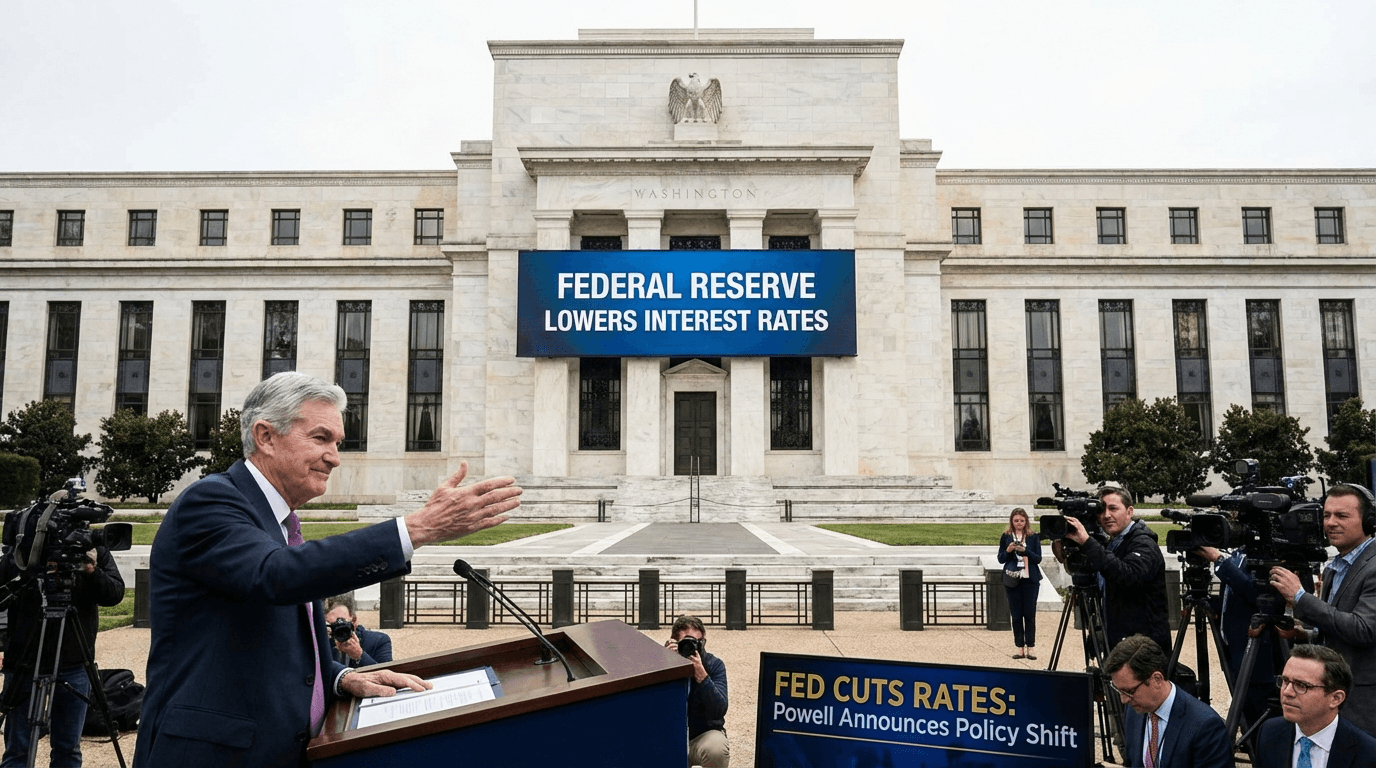
The Federal Reserve has implemented a third consecutive 25-basis-point reduction to its benchmark interest rate, setting the target range at 3.5% to 3.75%.
This decision reflects ongoing concerns about a softening labor market and inflation levels that remain above the central bank's 2% target.
The Federal Open Market Committee (FOMC) approved the policy change with a 9-3 vote.
Notably, Stephen Miran dissented, advocating for a larger 50-basis-point cut, while Jeffrey Schmid and Austan Goolsbee preferred to maintain current rates.
In its statement, the FOMC noted, "Available indicators suggest that economic activity has been expanding at a moderate pace. Job gains have slowed this year, and the unemployment rate has edged up through September. More recent indicators are consistent with these developments. Inflation has moved up since earlier in the year and remains somewhat elevated."
Additionally, the Fed announced plans to increase its securities holdings through purchases of Treasury bills and, if necessary, other Treasury securities with maturities of three years or less to ensure ample reserves.
Fed Chair Jerome Powell emphasized the strategic positioning of the current policy rate, stating, "Having reduced our policy rate by 75 basis points since September and 175 basis points since last September, the Fed funds rate is now within a broad range of estimates of its neutral value, and we are well positioned to wait to see how the economy evolves."
Powell acknowledged the delicate balance between inflation and employment goals, remarking, "Risks to inflation remain tilted to the upside and risks to employment to the downside—a challenging balance. There is no risk-free path for policy as we navigate this tension between our employment and inflation goals."
Looking ahead, Fed officials have updated their economic projections for 2026, forecasting real gross domestic product (GDP) growth of 2.3%, an increase from the previous 1.8% estimate.
The unemployment outlook remains steady at 4.4%, while the forecast for Personal Consumption Expenditure (PCE) inflation has eased to 2.4%, down from 2.6%.
Powell attributed the GDP growth revision partly to the effects of the recent federal government shutdown, as well as support from fiscal policy, consumer spending, and investments in artificial intelligence, which are boosting productivity.
However, Powell noted that a rate hike is not part of the Fed's base scenario.
Most officials project interest rates to end 2026 in the 3.25% to 3.5% range, implying one additional 25-basis-point cut next year, unchanged from September's outlook.
Seven officials anticipate no further reductions, while eight expect at least two more cuts.
Inflation reached its highest level since the start of the year in September, rising 3% year over year compared to 2.9% in August, according to the U.S. Bureau of Labor Statistics.
Meanwhile, the September jobs report exceeded estimates by adding 119,000 jobs, though the unemployment rate ticked up to 4.4%.
Jeffrey Ruben, president of home lending at WSFS Bank, commented on the Fed's stance, stating, "We see good growth this year and into next year as well."
Ruben added that while the labor market had appeared "unbelievably strong" until recently, inflation has been the persistent challenge.
The Fed now appears to be prioritizing labor market stability "in hopes of keeping the labor market strong and maybe fending off some of the labor losses that are being perceived in the economy," he said.
According to Ruben, the Fed continues to navigate a "very foggy road."
That uncertainty is reflected in the data.
According to Sam Williamson, senior economist at First American, the Fed still lacks official October and November jobs numbers, but "September's jobless rate of 4.4% already sits above the Committee's central range for 'maximum employment,' underscoring a softening labor market."
Bank of America analysts indicated that the base case for 2026 is steady rates, with the 10-year Treasury yield holding around 4.25% by year-end, along with U.S. gross domestic product growth of 2.4%.
However, they flagged a potential wildcard: a more dovish Fed leadership.
President Donald Trump is searching for a new Fed Chair to replace Jerome Powell, and Kevin Hassett, director of the White House National Economic Council, is reportedly the leading candidate.
"With a new dovish Chair, the Fed could potentially cut closer to 2%. The outlook for a lower Fed path could allow 10-year Treasury yields to drop to a 3.0%-3.5% range, down from our 4.25% forecast for year-end 2026," Bank of America analysts wrote.
Williamson expects a gradual path back to neutral, leaving 30-year mortgage rates in the low-6% range next year, drifting down slowly rather than returning to the 3% to 4% levels of the prior cycle.
According to Williamson, as home prices cool, incomes rise faster than prices, and rates ease at the margins, buying power could see "a measured, but persistent, recovery."
Sagent CEO Geno Paluso noted that mortgage rates are down nearly a full percentage point since January, although they actually rose after the Fed's cuts in September and October.
"We must keep servicers prepared to help consumers through all possible market outcomes, from capitalizing on lower-rate refis to navigating hardships," Paluso said.
Nash Paradise, director of sales for UMortgage, added that the recent declines in mortgage rates were tied to a combination of low liquidity and the jobs report showing more openings than anticipated.
Prior to this week's Fed meeting, "aggregating analysis was showing two cuts in 2026, with first possibly in April and the second in the third or fourth quarter," Paradise said.
Selma Hepp, chief economist at Cotality, offered tempered expectations for improved housing affordability.
"Prices remain strong and mortgage rates are unlikely to slip under the 6% mark for a 30-year mortgage, which will keep cautious first-time homebuyers on the sidelines, and overall home-buying activity seasonally slow until we come closer to the spring home buying season," Hepp said.
Regarding the housing market, Powell said he doesn't expect Wednesday's 25-basis-point cut in the federal funds rate to meaningfully change conditions, given today's limited housing supply and the large number of homeowners who still carry low mortgage rates from the post-pandemic years.
"Housing is going to be a problem," he said. "We can raise and lower interest rates, but we don't really have the tools to address a secular, structural housing shortage." |
0 Comments
Join the conversation
Be the first to comment
Share your thoughts above.