
Brevard Housing Market: Could a Seller-Paid Buydown Help? |
Current market conditions, mortgage rates and a $300,000 home example for Space Coast buyers and sellers |
Market and rate information checked October 21, 2026.
For Brevard County homeowners preparing to sell, the conversation often comes down to one number: the buyer’s monthly payment.
A seller-paid temporary mortgage buydown may help bridge that affordability gap, but its value depends on the home’s price, the buyer’s financing and the seller’s bottom line.
A look at the Brevard housing market
Brevard’s September 2026 single-family median sale price was $380,000, up 0.5% from a year earlier, while closed sales fell 2.5% to 818 and new pending sales dropped 16%.
Single-family inventory measured 3.5 months of supply, compared with 4.4 months a year earlier.
Townhouses and condos followed a different pattern: the median sale price reached $272,500, closed sales increased 6.8%, and supply stood at 5.9 months.
These figures from the Space Coast Association of REALTORS® suggest relatively steady single-family pricing alongside softer demand, with more supply relative to sales in the condo and townhouse segment.
Countywide medians describe completed transactions, not what any particular home will sell for; neighborhood comparisons, condition and property type still matter.
Where mortgage rates stand
Freddie Mac’s latest available weekly survey, dated October 15, 2026, put the national average 30-year fixed mortgage rate at 7.40% and the 15-year average at 6.71%.
Those averages are benchmarks, not a Brevard lender’s offer or an APR; a borrower’s quote depends on credit, down payment, loan program, points and other terms.
At that 30-year benchmark, temporary buydowns deserve a careful look because they can reduce the buyer’s early payments without requiring the seller to cut the contract price.
How a seller-paid buydown works
The seller funds an account that supplements the buyer’s payments for a limited period, while the mortgage’s actual note rate remains unchanged.
A 2-1 plan calculates the buyer’s payment at two percentage points below the note rate in year one and one point below it in year two, with the full payment beginning in year three.
A 3-2-1 plan starts three points below the note rate, then two, then one, before the full payment begins in year four.
Fannie Mae’s temporary buydown rules require borrowers to qualify at the note rate, so the subsidy does not create extra qualifying power.
The $300,000 home example
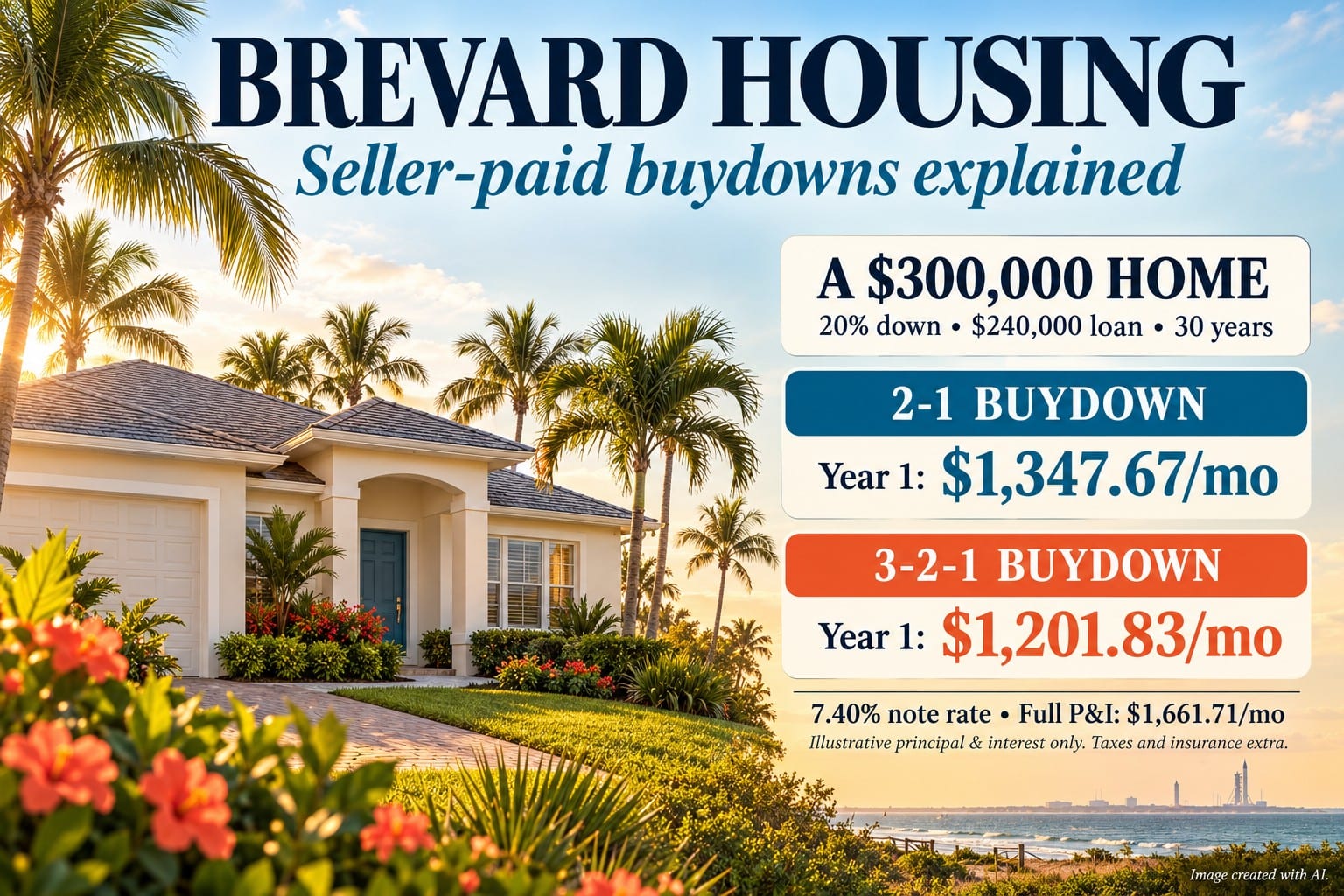
Assume a $300,000 purchase, a 20% down payment of $60,000, and a $240,000 fixed mortgage amortized over 30 years at a 7.40% note rate.
The regular monthly principal-and-interest payment is approximately $1,661.71.
With a 2-1 buydown, the buyer pays approximately $1,347.67 per month in year one, calculated at 5.40%, then $1,501.21 in year two, calculated at 6.40%.
The payment reaches $1,661.71 in year three and remains there for principal and interest under the fixed loan terms.
The seller’s estimated subsidy is $5,694.42, covering the payment differences over those first 24 months.
With a 3-2-1 buydown, the buyer pays approximately $1,201.83 in year one at a 4.40% payment-equivalent rate, $1,347.67 in year two at 5.40%, and $1,501.21 in year three at 6.40%.
The full $1,661.71 payment begins in year four, and the estimated seller-funded subsidy totals $11,213.04.
These calculations use unrounded payments before rounding the totals; a lender’s final worksheet may differ slightly.
All figures exclude property taxes, homeowners and flood insurance, HOA or condo charges, mortgage insurance if applicable, other closing costs and any separate program fees.
What homeowners should compare
Before other selling expenses, the $300,000 price minus the subsidy leaves approximately $294,305.58 with the 2-1 option or $288,786.96 with the 3-2-1 option.
That is a real cost to the seller, even though the contract price stays at $300,000.
Ask the lender and real estate agent to compare the same seller budget across a temporary buydown, a price reduction, a closing-cost credit and permanent discount points.
A price reduction lowers the financed amount and purchase cost; permanent points may lower the rate for the loan’s life, while a closing-cost credit may preserve more of the buyer’s cash.
Program limits matter: under Fannie Mae’s rules, an 80% loan-to-value primary-home purchase generally allows financing concessions up to 6% of the lower purchase price or appraised value.
If that value is $300,000, the ceiling is $18,000, shared by the buydown and other counted concessions rather than reserved solely for the subsidy.
Smaller down payments can mean tighter limits, and lender availability and other loan programs differ.
Plan for the payment after the subsidy
Buyers should budget for the full payment plus ownership expenses from the start and review how unused subsidy funds are handled if the loan is paid off early.
A future refinance is not guaranteed, and a temporary buydown does not reduce payments on an existing homeowner’s current mortgage.
For Brevard sellers, the practical next step is a written lender quote and a side-by-side net-proceeds comparison before offering a concession.
This example is educational, not a loan offer or individualized financial advice. |
0 Comments
Join the conversation
Be the first to comment
Share your thoughts above.