
Port Canaveral: From Historic Landmark to Global Cruise Hub |
Tracing the Evolution of Florida's Premier Seaport |
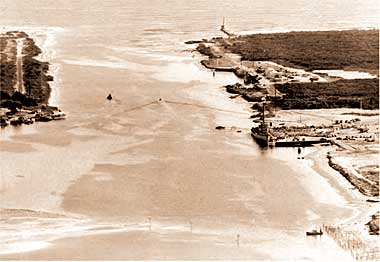
Aerial view of the harbor inlet on Dedication Day, November 4, 1953. (Port Canaveral image)
Port Canaveral, located on Florida's east coast, has a rich history that spans centuries, evolving from a strategic landmark to a bustling center of maritime activity.
Historical Significance
In 1513, Spanish explorer Juan Ponce de León landed near what is now Melbourne Beach, just south of Cape Canaveral. This area, known as the "Place of the Cane Bearers," holds the distinction of being the oldest geographical name still in use in the Western Hemisphere.
Early Development Efforts
Efforts to establish a deep water port at Canaveral date back to 1878 when the U.S. Navy proposed its construction. However, the project faced multiple rejections due to perceived limited economic value. It wasn't until 1929 that the U.S. Engineers' Office in Jacksonville found justification for the project, leading to the establishment of the Canaveral Port Authority in 1941.
Construction and Dedication
In November 1947, local freeholders approved a bond issue to fund the port's construction. By October 1951, a channel was cut from the harbor to the sea, allowing the Atlantic Ocean to merge with the Banana River. The official dedication took place on November 4, 1953, marked by grand celebrations and an address by U.S. Senator Spessard Holland, who called it "Our nation's port for inner and outer space."
Modern Growth and Expansion
Over the decades, Port Canaveral has transformed into a major hub for cruise and cargo operations. In March 2025, the port set a new monthly record by hosting 925,994 cruise passengers, a 16% increase from the previous year. This surge in activity has positioned Port Canaveral as the world's busiest cruise port, surpassing even Port Miami.
To accommodate this growth, the port has embarked on a $500 million capital investment plan. This includes expanding Cruise Terminal 5 by 65% and enhancing Cruise Terminal 10 to accommodate larger vessels. Additionally, a new multi-user Cruise Terminal 7 is slated to be operational by summer 2026.
Economic Impact
The port's expansion has significantly boosted the local economy. In Fiscal Year 2025, Port Canaveral generated $218 million in total revenues, with cruise operations contributing $182 million. The influx of cruise passengers has also led to increased hotel construction and local business growth, further solidifying the port's role as an economic powerhouse in Central Florida.
From its early days as a strategic landmark to its current status as a global cruise hub, Port Canaveral's history is a testament to vision, perseverance, and growth. |
0 Comments
Join the conversation
Be the first to comment
Share your thoughts above.